CNC Machining Tolerances: What They Are and How to Achieve Them?
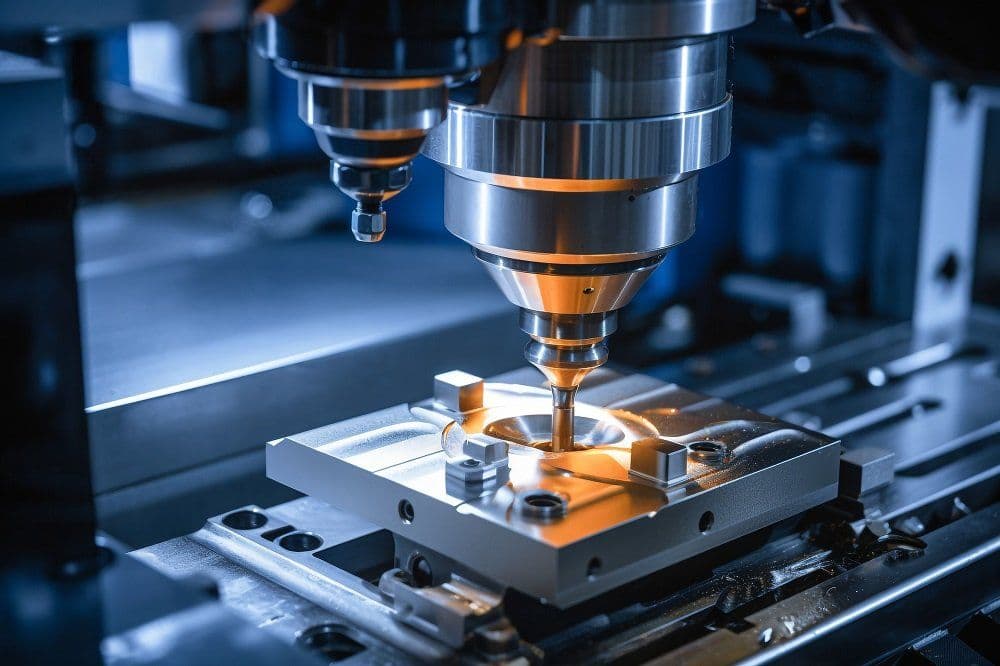
Imagine ordering a shaft that must fit into a bearing. If the shaft is 0.2 mm too large, it won’t enter. If it’s 0.2 mm too small, it will rattle and fail prematurely. This is where machining tolerance comes into play.
In simple terms, tolerance is the permissible deviation from a designed dimension. It defines the acceptable range between the maximum and minimum limits of a feature – such as length, diameter, or depth. No manufacturing process is perfect; tools wear, temperatures fluctuate, and vibrations occur. Tolerances tell engineers and machinists: “You don’t have to hit the exact number, but you must stay within this zone.”
In the world of CNC machining, tolerance is the invisible thread that separates a functional part from a failed one. But what exactly is machining tolerance, and how do manufacturers consistently achieve it?
Whether you're designing aerospace components, medical devices, or automotive parts, understanding tolerances is essential. This article breaks down the concept of CNC machining tolerances and provides actionable strategies to achieve them—backed by real-world practices from Dongguan Longwang Hardware.
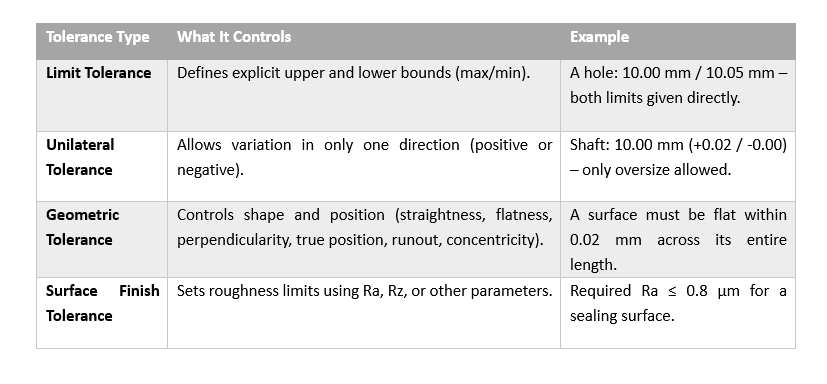
Understanding the different tolerance categories helps you communicate design requirements clearly. Here are the four main types:
Not all CNC processes are created equal. Here’s a quick reference guide:
Pro Tip: Tighter tolerances dramatically increase cost. Always specify the loosest tolerance that still meets functional requirements.
Tolerances aren’t just numbers on a drawing – they impact every stage of product development.
Now let’s get to the heart of the matter – how do you actually hold tight tolerances on the shop floor? Based on years of experience at Dongguan Longwang Hardware, we break it down into five pillars.
Modern high-precision CNC machines are built for micron-level accuracy. Key features include:
If the machine frame lacks rigidity or has high thermal expansion, holding ±0.01 mm is nearly impossible.
Rigidity is the foundation of precision. A machine that vibrates or flexes under cutting force will produce oversize or out-of-round features. Look for:
Equally important: cutting tools. Sharp, well-coated tools (e.g., TiAlN, DLC) generate lower cutting forces and better surface finishes. Replace tools before they become worn – a dull tool is a precision killer.
Tool holding (spindle + collet/chuck): Spindle runout directly transfers to the cutting edge. Use high-precision holders (e.g., HSK, shrink-fit) with runout < 0.005 mm.
Workholding (fixtures, vises, chucks): The workpiece must be clamped rigidly but without distortion. Poor clamping can deform thin-walled parts, causing spring-back after release. Custom fixtures, vacuum chucks, and hydraulic clamping systems distribute force evenly and prevent vibration.
Temperature is the silent enemy of precision. A 10°C change can expand a 100 mm steel part by about 0.012 mm – enough to scrap a tight-tolerance job. Best practices:
Cleanliness also matters. Chips, dust, and residue can cause incremental wear on guideways and ball screws, gradually degrading accuracy.
Even the best machine is only as good as the person running it. Skilled CNC programmers:
Good G-code programming isn’t just about making chips – it’s about making consistent chips, pass after pass.
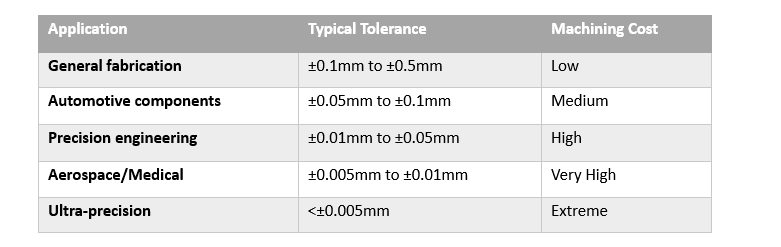
Here's a practical reference for common tolerance requirements:
CNC precision machining is a subtractive manufacturing process that uses computer-controlled machine tools to remove material from a workpiece to create parts with extremely tight tolerances and fine surface finishes.
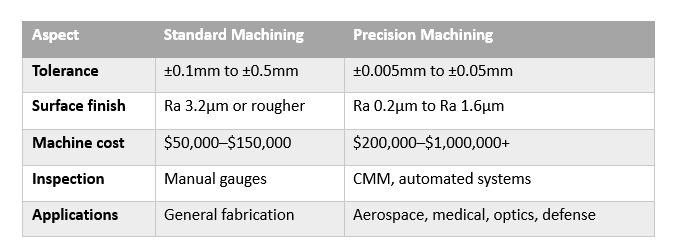
Machining tolerance is not a restriction – it’s a specification of quality. It tells the supplier what is acceptable, the operator what to aim for, and the customer what to expect. By understanding the types, ranges, and methods to achieve them, you can design better products, reduce scrap, and control costs.At Dongguan Longwang Hardware, precision CNC machining is our core competency. With over 18 years of experience, ISO 9001,IATF16949 certification, and a commitment to continuous improvement, we deliver precision parts that meet the most demanding specifications—on time and on budget.
Next

How to Design Parts for CNC Machining?
2026-04-03Learn how to design parts for CNC machining with this comprehensive guide covering tolerances, undercuts, thin walls, and best practices for complex custom parts.
7 Sheet Metal Fabrication Techniques in Modern Manufacturing
2026-06-30Discover 7 core sheet metal fabrication techniques—from blanking and forming to joining and finishing—covering principles, uses, and cost efficiency for optimized manufacturing.

Get in Touch With us
Helping customers grow steadily and achieve win-win development

Your trusted partner for CNC machining, sheet metal fabrication, stamping, and assembly. From prototyping to mass production with strict quality control.
tel:
0769-82763299
Mobile:
+86 18988716988
fax:
0769-82763199
Address:
No.3 Longze Road, Chang'an Town, Dongguan City, Guangdong Province, China,523861


Copyright © 2008-2026 | Dongguan Longwang Hardware Co., Ltd. | All Rights Reserved.


